Thursday, January 13, 2011

What are the rates?

What do you get when you stick three Americans in India?  (If bowel problems was your first thought…then you wouldn’t actually be wrong). But otherwise you get an awesome time exploring some of the greatest sights in the world.

I recently met up with Mr. Rahul Barwani, who traveled the long distance from Berkeley, California, and Mr. Josh Brown, a Fulbright-er currently teaching English in South Korea, for a two week bonanza through northern India.  For me, it was a nice break from the routine here in Andur.  And to be able to spend New Years in Mumbai…what more could I ask for.

So I packed up and boarded a car, then bus, then rickshaw, then train to get over to Mumbai to meet up with Vickybhai, Rahul’s first cousin that lives in there.  The two of us then boarded a quick flight and made our way up to Delhi, the capital of India and the beginning of our journey.  We were soon accompanied by Rahul and Josh, arriving on flights from Kolkata and Seoul, respectively.  And thus we began…the four of us (and Sushil…our driver). 

First stop, Delhi.  Delhi, as the capital of India and the recent host of the Commonwealth Games 2010 (an athletic competition between former colonies of the British Commonweath) had a lot to say for itself.  As a little village bumpkin who has only really scene the chaos of Mumbai, I was amazed by the relative orderliness of the Delhi streets (people actually drove IN their LANES) and the cleanliness of the city.  We spent a day exploring the different sites around the city, including the:

Qutb Minar – erected in the 12th Century, it is one of the most historical and prominent symbols of Delhi.  It's a great example of Indo-Islamic architecture as it was built by an early Muslim ruler in India.
The Qutb Minar.
Lotus Temple – a holy site for people of the Bhai’i faith.  They told us a bit about the religion there…unfortunately I don’t remember too much.  What I do remember is that they believe in universal peace and equality between men and women.  Also, interestingly enough, a tenant of the religion is obedience to one’s government.
Lotus Temple...because it looks like a lotus.  Get it? 
Humayan’s Tomb. . A mausoleum for Humayan…some dead old ruler/conquerer.  This was actually a model for the Taj Mahal, which was constructed in the same style but on a grander/more magnificent scale.
Compare this against the Taj Mahal picture later in the blog.
Any similarities?
Gateway of India – a remembrance for all fallen Indian soldiers.  Interesting story: there were a group of African people visiting this site who attracted huge attention from domestic (Indian) tourists.  As a white American, I get a lot of attention in the villages I visit.  So it was interesting to be an outsider to that same experience and see the attention given to others.  These people were loving it though.

Raj Gat – where the cremated remains of Mahatma Gandhi (the leader of the Indian freedom movement) lie. 
The Man himself.
Jantar Mantar – an observatory in the middle of Delhi built in the 1600s.  Although this place has some historical significance, it seemed to us more of a big playground than anything, complete with structures looking like a half-pipe and another like a gladiator pit (apparently they were used to track celestial bodies.  How? Don’t ask)
The Colosseum-like structure. Rahul's expression says it all.
Next stop, Haridwar. Haridwar is a city pretty far North in India where the Ganges starts flowing.  Therefore, in Hindu culture, it’s an important place.  The mythology behind the Ganges is that the river flows from the head of the Lord Shiva, an important God in Hinduism.  As much as I’m sure you’re interested in the theological underpinnings of the city, I’m sure you’d be more happy to see…MONKEYS.  Yes, Haridwar is also home to two temples, both of which many monkeys call home.  Therefore, you can imagine the excitement of Rahul, Josh, and myself as we attempted to feed monkeys at the temples located on the hills surrounding the city.  Unfortunately, the monkeys also bombarded Josh and the ice cream he was holding in his hand.  You can correctly assume that he didn’t get to eat too much of it before he had to give it up to them.
Does anyone else see the resemblance here? 
But the magical part of Haridwar comes at night, when visitors throng the sides of the Ganges river and partake in the nightly pooja, or prayer, that happens.  It really was a beautiful site, with thousands of candles lit up and hundreds of people following along to the prayers.
It's gorgeous.  Add to this the voices of hundreds following
along in prayer.
Rahul, Josh, and I also were able to partake in the ceremonial prayer of the Ganges.  It is composed of having prayers said over you by a religious leader on the side of the river, dunking in the water, and giving an offering to the river.  Josh, thanks to his dearth of Hindi language, dumped the offering into the river PLUS the plate that was holding it (I think you had to be there, but Rahul and I really got a kick out of this one).
The four us watching the pooja.
One of the great parts of being in Hardiwar was that I was actually able to impress some people with my Marathi skills.  Sitting at a restaurant for lunch just as we’re about to leave the city, a group of women at the table behind us tapped our shoulder and asked “America?”  We replied yes, and then asked them in Hindi where they were from.  They replied “Maharashtra.”  This got me going, and I asked, in Marathi, if they spoke Marathi (Tumhi Marathi boltaka?).  Surprised, they replied in the affirmative, and we had a brief conversation about where they were from and what I was doing speaking Marathi.  It was great to be able to use my Marathi outside of the village of Andur, and really boosted my confidence in my speaking ability.

Moving on, a quick overnight stop in Rishikesh…an extremely spiritual place that is full of ashrams (similar to what I lived on during my orientation).  The Beatles actually came here and composed a fair amount of music at one of the ashrams (now closed).  I don’t’ know if I mentioned it, but it was FREEZING cold during this trip, with nights going down to 5/6 degrees Celsius (that’s about 40 Farenheight).  I definitely didn’t sign up, or pack, for this kind of weather…

We then made our way up to Punjab and the city of Amritsar, a holy place for people of the Sikh religion. It was about this point that Josh and I were both overcome with…Delhi Belly.  I’ll spare you the gory details, but let’s just say that a bathroom became an essential part of the rest of our journey. 

Amritsar is way up in the North of India, right by the Pakistan-India border.  Daily, a huge, nationalist ceremony is held at the border in which Indian and Pakistani soldiers parade fanatically in front of each other from across a small gate.  Add to this hundreds of crowds (on both sides), flag waving, and chants and you have what looks like a Cal-Stanford football game.  There is a lot of historical tension between Pakistan and India (more than I want to go into in this post), so it was interesting to see that play out before your own eyes. 
Down the road in the center of the picture past the gate is
Pakistan.  Spectators throng both sides to see the "show"
every night at 5:30pm
.
Back to Amristar: This city is home to the Golden Temple, or the holiest place for people of the Sikh religion.  The Sikh people traditionally wear turbans (it is a religious custom that men and women will not cut their hair).  We went early in the morning, just as the sun was rising over the temple.  It is surrounded by a body of water, making the whole place feel extremely calm and surreal.  It was like an oasis in the middle of the city.  Similar to all gurdwaras (Sikh temples), it is customary to offer food to all visitors.  Therefore, we joined the line of other guests and worshipers and sat down for breakfast (a nice meal of dhaal, chickpeas, and chappati). Given the high tourist traffice, this place busts out 80,000 dishes per meal! 
Posing in front of the Golden Temple.  It's customary to cover
 your hair when entering a Gurdwara.
We then made our way back through Delhi (passing through a part of India that legitimately looked like the apocalypse: dark, foggy, ghost towns) and made our way to Mathura which is where the Lord Krishna (a main Hindu god) grew up.  There is a large temple there dedicated to him.
A little American indulgance.  Do we look excited?
And finally, what I know you’ve all been waiting for…Agra, home to the Taj Mahal.  By this point, we travelers were so weary and exhausted that it’s no wonder we were excited by:
Yep...the Taj Mahal.  Although the most attractive part of
 the photo is in the foreground.
It truly is a masterwork of architecture, with gorgeous stonework and marble detailing.  For those of you who are unfamiliar with its history, the Taj Mahal is a mausoleum built by the Mogul emperor Shah Jahan in the 1600s for his wife, Mumtez. 

And then, on to Bombay…and some relaxation.  To put our previous trip into perspective, we traveled about 2500 km in 6 days.  That’s a lot of car time, a lot of hotels, and a lot of sights.  So coming to Bombay for a little rest was much needed by the end of our journey. 

Here’s where I want to take a brief pause and pay my deepest tribute and upmost respect to the Barwani family.  Rahul’s family in Bombay greeted us weary travelers as members of their own, taking us within their arms and literally bringing us back to health.  Through delicious, home-cooked, non-vegetarian meals, satellite TV, and a little TLC the three of us were able to recover from our hectic journey.  We spent much of our time in Bombay relaxing, slowly venturing out into the suburbs of Khar and Bandera where we were staying.  But mostly laying low and meeting up with different parts of Rahul’s family.  
With part of the Barwani Family.  again...THANK YOU!
Did I mention there was a bagel shop in Mumbai? Fellow
"fellow" Sami posing in front. It's like a Jewish heaven.
New Years was a blast.  Maybe not the craziest one I’ve had, but definitely the most relaxed and mature.  The three of us, along with Rahul’s cousin and another couple, went to an extremely gourmet, Pan-Asian, buffet restaurant.  Well, right on Indian Standard Time, we got there at about 10pm.  Didn’t eat until 1:00 a.m.  And left around 3:00 am.  Along with some great cuisine, we had fantastic conversation and were really able to bring in the New Year with style.
Bringing in the New Year! The guy's end of the table.
Now for some introspection.  Right before we got into the restaurant, as we were waiting outside with other people all dressed to impress, I couldn’t help but notice the child that was going from person to person, hand out, asking for money.  Being in India for a stint (and especially as a foreigner), you almost become immune to the endless people that come up asking for money.  I have personal reasons for not giving money to people on the streets (it’s not a sustainable way to help people get into poverty, only further snowballs the effect of begging, etc.).  But this time it really hit me…the blind eye that I usually turn to such things wasn’t so blind.  We were standing there, getting ready to enter and gorge on a delicious buffet, dressed up and ready to celebrate the coming of a new year.  And here was a little girl, maybe 7 years old, who might not have had a home, family, or meal.  It really put things in perspective for me…that even when I’m in India and realizing all that I take for granted in the US (hot showers come to mind), I still stand in a very privileged place where I have so much to be thankful for.  It also made me thankful to those who are continually work to help alleviate poverty in parts of the world where its a very common tragedy.  

Aside from that, we made our way to the Taj Mahal Hotel, probably the nicest hotel in all of India, but also one of the sites of the shooting on November 26, 2008 – an event in which Pakistani terrorists killed over 100 innocent people around the city of Mumbai.  Similar to 9/11 in the US, it unified the Indian people .  So the Hotel has stood as a testament to the vivacity of the nation. It has bounced back and really is a gorgeous hotel…if only we could have stayed there a few nights…
The Taj Mahal Hotel.  This picture doesn't do it justice
And that marked the end of my vacation.  I boarded a train and made my way…10 hours later…to my cozy home here in Andur.  It was nice to be back, and to realize that the life I had left is still here and constant.  Fortunately, I came back on a holiday (meaning no work), and was able to celebrate with some prayers and a special meal with all the residents here.  The holiday is Yelvasmoushi (sp?) and celebrates the harvest and 5 god-like beings who defeated evil (not quite sure of their names or the story, but that’s all I remember).  
Celebrating Yelvasmoushi(?) in the NGO garden we have here.
Overall, my trip was a nice getaway from the relative calm here in Andur, and it was nice to meet up with some long-time friends. 
A map of our travels.  Follow the dotted blue line to
see my journey to Delhi (pit stop in Bombay),
and the solid blue line is our trip together.
Just putting it out there, if anyone else wants to make the journey, there is plenty to see in this big country!

I hope you all had a great new year! 

Andrew

Sunday, December 12, 2010

Adventures!

See…I thought I had done it…successfully integrated myself into life here so that I can carry on my days of working, eating, and sleeping.  I have learned some of language, eat properly with my hands, and even throw on a kurta now and then (traditional Indian shirts).  But how fooled I was.  It turns out that a white, tall American in the middle of rural India can attract some attention.

Me with some of my coworkers in Bokarwadi, a village of about 
500 people.  We're standing at the base of a dam which floods 
hundreds of acres of land during the winter months.
For the last two weeks, the NGO has been running a Gender Equity Campaign in the next “county” over.  Through 25 villages, a select group of staff and outside support had devised a skit, various songs, and discussions for the villages in order to promote the place of women in society.  For communities that don’t get much entertainment, and whom mostly cannot afford televisions (although camera phones seemed to be extremely prevalent), a night of activities can bring out a fair number of people.  And the campaign was dealing with some really important issues: child marriages (encouraging marriage after the age of 18), sex-selective abortion (currently illegal in India but widely practiced), and domestic violence.

A rally through the streets of Akkolkot during the final day of the 
Campaign.  About 150 people were a part of the rally at this point.
For a few days, I went along with the campaign to help out/video tape the work.  The size of the villages varied, anywhere from 500 people to 2500.  But the reactions were…similar. Turns out, an American showing up can be pretty exciting for…well…almost everyone in the community.  If I had a nickel for the number of times my hand was shaken, autograph asked for, or tea drank I would be a very rich man right now.  For me, it was amazing to be taken in by these communities and really shown the heart of Indian hospitality.  For my coworkers, I could tell that some were frustrated that my presence sometimes caused excess disruption. 

But overall, I came away with an deep appreciation for the work that my NGO is doing.  In the US we often take for granted that people can choose whom they want to marry and that cases of domestic violence can be swiftly reported.  In India (and especially in rural communities), options aren’t as easy for women. I can’t speak from experience, but from what I’ve seen husbands and mother-in-laws can be brutal to a woman (upon marriage, a woman goes to live with her husband’s family).  Domestic violence is common, and cases are usually resolved in having the family come back together rather than through options of divorce or criminal proceedings.  Through this campaign, my NGO was not only combating outdated social norms, but helping to empower women in all aspects of village life.


The women audience from one village watching the program.
So, my NGO would enter a villages and hold rallies through the streets with children shouting slogans like “Eksaman Eksaman Moulga Moulgi Eksamam” (Equality Equality Boys and Girls are Equal).  This would then be followed by a public performance of songs and speeches about the importance of women.  Finally, a serious and humorous skit to show the reality of the situation.  They then brought in the community by holding a discussion with everyone present about what the village can realistically do to encourage equality between men and women. People spoke up, both men and women, emphatically declaring that they would stop such practices and work towards are more equal community. I was motivated by the seemingly empowering work of the NGO.  But I was also left questioning: yes this work is great, but what happens when we pack up and leave.  Are there any real changes made in the community?  Will these lessons be taken to heart?  I guess only time will tell.


A children's rally through the streets of Dershegao.


A snapshot of the skit.  At this point the the mother-in-law (in the middle)
 is beating the new bride (on the right) because of unclean plates.
On another note, winter has officially set in.  Precisely on December 1, the weather changed, turning nice, breezy 70/80 degree weather in the day to bone-chilling 50 degree weather at night.  I can definitely tell that the infrastructure here was made for hot summers – that includes the people who bundle up under loads of extra layers during the nights.  So needless to say the one sweatshirt I brought has been getting a lot of use the past few days.

In terms of work, my NGO held a ceremony a few weeks back to culminate an Essay Competition that was held back in September.  The Competition is a part of the Rural Science Center, one aspect of the NGO which provides science education to local schools that lack modern science tools and equipment.  To complement their work, they hold an essay competition every September for grades 7, 9, and 11.  This year, almost 1000 students participated.  The themes for the essays dealt with topics like HIV/AIDS solutions and village health infrastructure.  It was a great ceremony, and it was exciting to see the enthusiasm of the students as they received their awards.

At the awards ceremony.  About 200 students were packed in 
this hall.
Other than work trips, I’ve been able to take another venture away from the village of Andur.  For a weekend, I dared the crossing into another state, Karnataka, which borders Maharashtra to the south.  Destination: Bidar.  A small, quiet town boasting some historic sights and GREAT chicken biryani (I was more than happy to indulge).  The reason, my boss’ son needed to go to his college to grab a transcript.  So I packed my bag and left for an excursion. It was nice to get away, but one little snag: in Karnataka they speak Kannada, a language completely different from Marathi.  So I was again forced to be the out-of-place foreigner.. I think that’s going to be a theme of my time here.  Some activities of the weekend:

Bidar is famous for its local artwork, Bidari.  Objects (including 
plates, figurines, chotchkies, etc.) made of iron ore are burned so 
that they become black.  Then, pure silver is hammered into the 
pliable metal in intricate designs.  The plate above is a work in
 progress.  They even let me, with absolutely no hand-eye 
coordination, give it a try.  But don't worry, I bought a few 
things to bring home.

The Bidar Fort.  Pretty cool.  Built in the 1600s.


Posing in front of a Gurdwara, a temple for people of 
the Sikh community (the community that typically 
wears turbans - hence why my head is covered).  
This is the 3rd holiest Gurdwara of the Sikh faith.
In case some of you forgot (or didn’t know), it was Hannukah this past week.  Fortunately, I had a staff of dedicated individuals to help me light the candles and say the prayers each of the 8 nights.  I transliterated the prayers from Hebrew into Marathi (actually a pretty difficult task) so that the students of the Nursing School who live here could follow along.  They were extremely interested in learning about my heritage, making me tremendously proud of being able to share a piece of my culture with them.  They had never heard of Jewish people or Judaism, so I was able to really start from the beginning.  I likened Hannukah, the Jewish festival of lights, to Diwali (celebrated at the beginning of November), the Hindi festival of lights. 

Celebrating the second night.  As you can tell, people were really excited. 

By the eighth night, we had a crowd going.  I'm really 
happy that I got to share a piece of my culture with 
everyone.
Coincidentally enough, the last day of Hannukah marked the beginning of a Hindi holiday (wait, another holiday…yep).  This one is for the goddess Lakshmi, goddess of wealth.  A pooja (prayer) is said on the evening of December 8 and then another pooja is said 8 days later – are you seeing the same similarities I am?  So, as my holiday ended, theirs began.  It’s like it was meant to be!

One student giving pooja to Lakshmi.  After this photo, 
EVERYONE wanted a picture giving pooja.  
This turned into a 30 minute photo shoot.  
A picture with some colleagues during the 
above said photo shoot.  Apparently no one
 else got the cue to smile...

Well, I’m off.  The great Rahul Barwani and Joshua Brown are coming to join me in India for a fantastic adventure!  I bid you adieu and hope that I come back in one piece (you never know these two). 

 Andrew

Did I forget to mention...puppies! (Ok, they kind of look like rats, 
but they're adorable in person.) Yes, those dogs which continue
 to incessantly bark at 6:30am every morning have given birth
 to a  set of 6 puppies.  These guys are about 4 days old -- haven't 
even opened their eyes yet.

Tuesday, November 23, 2010

The Many Faces of India

Well, as the title suggests and as can easily be assumed, India is not a one-sided coin and presents a mirage of different experiences, places, peoples, cultures....you name it.  However, in the past few weeks I have been witness to some of the starkest extremes in Indian living: megacity and rural village.  I was able to do some traveling give the Diwali holiday (read below), and conducted some field visits for work in the visits around my NGO.   The differences between the two showed me how people living in the same country can lead completely different lives.

November 5 marked Diwalli – basically the most awesome celebration in all of India.  I’m not sure of the religious significance (and neither are most of my companions here), but it is the Indian New Year and the “Festival of Lights”.  For me, that means 5 glorious days off from work and the opportunity to explore!  So, I packed my bags and made my way to Pune and Mumbai, crashing at the apartments of my fellow “fellows” with almost the entire group of us meeting up in Mumbai to celebrate the holiday.

Pune
I got to spend 3 days in this city, and boy was it a treat!  Pune is definitely a middle-class city that lives up to its reputation as a cosmopolitan hub.  The streets are wide and clean, the people are generally metropolitan, and the culture is very lively and upbeat.  And, not to mention, there were WHITE PEOPLE.  Now, I can’t express to you my surprise when I realized that I was in fact NOT the only foreigner in India.  I think my seclusion in the depths of Anadur had caused me to forget this little fact.  To tell you the truth I couldn’t help but stare.  It took a few days for the awe to wear off....

Pune isn’t the most historic of places, but had a good selection of restaurants, tree-lined college streets, and coffee shops.  Plus I got to spend time with three fellows whom I hadn't seen in over a month.  It was a nice, relaxing break.  To tell my story through pictures…


A view of the Pune skyline.  Notice anything different?  
No, because it looks like any other American city.

Akash Devies: These are sold on the streets during 
Diwali season.  They're hung outside the home 
with a lit candle inside.  Thus, the Festival of Lights!

Shaniwar Wada, the one historic place in India. 
This is a small fort in the middle of the city 
dating back to the 1600s.  We attempted
 to get in at the Indian cost (5 Rupees as opposed to
 100 for foreigners), but were quickly spotted 
as...well...not Indian.  So, we had to shell out 
the 100 Rupees.  What a shame....

The three other "fellows" that met up 
in Pune.  Seth, on the left, lives in Pune and we 
are so grateful for him allowing us to crash his floor!

Mumbai
Well, let’s get it straight.  This is a BIG city, and the description of my 2 day visit will not do it justice. As the second most populous city in the world with over 14 million people, Mumbai is a collage of globalization, poverty, and consumerism.  Mumbai is home to the third largest slum in the world, as well as upper-class neighborhoods that could rival any Bel Air has to offer.  Our friends lived closer to the latter of those options, which is also were we spend the majority of our weekend.  But the squatter slums are easily seen from the local train (the heartbeat of the city).  However, I was there when our President was there! We did lunch….

But let me just explain to you.  I arrived in Mumbai on November 5, the day of Diwali.  The favorite pastime of all Indians during this holiday is to: light fireworks.  Not the harmless sparklers that we think of, but the explosives that one could illegally buy in Chinatown: firepower that sounds like bombs, huge fireworks Independence Day-style, bottle rockets, etc.  And not to mention that these are lit at all hours of the day.  Meaning that explosions could be heard at 2 am, 4 am, 6 am…. I hope you get my point.  But there was an upside: sitting on the roof of a friend-of-a-friend’s apartment at night and being able to watch the whole city light up.  It was beautiful.

Some kids preparing to set off a firework... 
This one in particular made my ears ring for about 
3 minutes afterwards.

Chowpatty Beach.  A family friendly place to 
gather at sunset.  Not necessarily safe for swimming (sewage can 
be seen spilling into it), but pretty nonetheless.

A street in Bandera, an upper-class neighborhood
 in Mumbai.  Further up this street is the...BAGEL 
shop (no, i didn't type that wrong)!  Yes, there is a bagel
 shop in India.  Unfortunately I don't have pictures (of the shop
 or the 2 bagels that I ate).  Next time...

The train station at Bandera.  The local trains are the heart of this 
huge city.   Think of it like the New York City subway, but only much 
more intense.  The train passes through some of the largest 
slums of the city, giving me some great perspective of where I am.

Yep, a tribute to Mr. Obama.  I think someone might have forgot
 to check their grammar though....

WADA PAV! (also known as the Bombay Hamburger...no meat though). 
The most popular snack food in Mumbai.   It is basically a ball of 
mashed potatoes that is deep fried and served in a bun 
with tamarind sauce.  Yum Yum!


Field Visits
Now let me provide some contrast to the above experience.  This week, as a part of my work, I had the opportunity to do some field visits to seven surrounding villages.  The main reason for my visit was to analyze the work of the Women’s Microfinance Groups.  (for those of you unfamiliar, a microfinance group is a small group of 10-15 ...usually women... who save small amounts of money each month and are able to take out loans at low interest rates.  In our case, 2% interest).  So I was able to sit in small groups to discuss their work, and the efforts they had made to help empower women within the village to tackle larger issues in their communities.  What I didn’t expect was the warmth and openness with which these women received me – candidly telling me their stories, worries, and actions in order to help me better understand their plight.  It was….eye-opening.  I heard stories of domestic violence, one in which a woman braved her abusive husband who would lock in her room for days on end without food and beat her for no apparent reason – other than the alcohol he spent all the family’s money on.  Or the discussion among women of one village who were complaining about the deleterious effects of alcohol (and it’s subsequent abuse) and their plan to rally the rest of the women in the village to stop the illegal sale of it in the village. I was amazed by the confidence these women had in tackling the issues of the community.  And I hear it’s partly thanks to the work that my NGO has been doing here over the past 10-20 years.  Apparently before, these women would be timid to speak in front of (male) visitors, and were unwilling/unable to discuss village issues on a group level.  But now, not only are they confident, but they are ready to take a stand for these issues and help transform the lives of themselves and futures for their children.  Needless to say, I left extremely impressed.

Speaking with the women of a microfinance gorup in Hipparga, 
population 4000.  

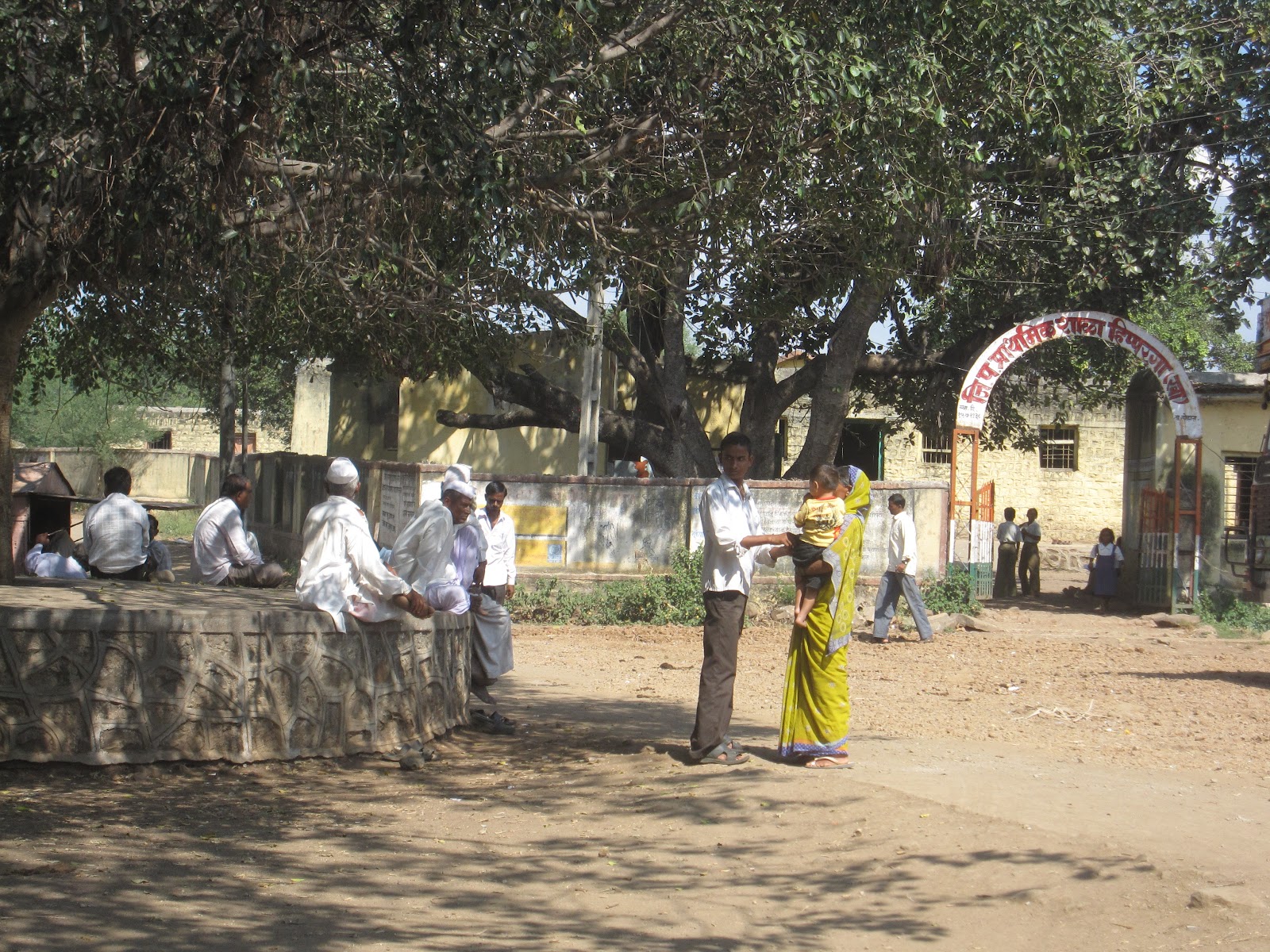
The central "square" of Hipparga.  Ahead on the right is the primary 
school for the village.

Representatives of a microfinance group in Bhatagali.  We're sitting 
in the courtyard of one woman's home.  The floor is made of a special 
material which helps to conserve heat: dried cow dung.

A women's microfinace group in Keshegaon, population 6000.
Food
And of course I know you're interested in what I'm eating.  Thus, I was able to snap a picture of a typical meal.  Here we have, staring counter-clockwise from the top: sambar (liquid lentils with spices), green bell peppers cooked with chillis, chappatti, and rice.  This type of meal is served almost every lunch and dinner with only the vegetable changing.  For some reason, I still haven't tired of it....

Directions on how to eat: using ONLY your right hand, you tear a piece of the chappatti and scoop up some of the vegetable.  If you feel like it, you may dip in the sambar (in the bowl).  Once chappatti and vegetable are finished, you pour the remaining sambar over the rice and eat, again ONLY with your right hand.


Hope you all enjoyed!  Have a fantastic Thanksgiving!


Andrew

Tuesday, November 9, 2010

A little bit of culture...

So, I thought that this blog around I’d give you all some useful tips about living India.  I’m going to start with the basics – not because I don’t think you can’t handle it all – but because I don’t want to scare you off too quickly.

Tip 1: Crossing the Street
Now, I want you to imagine that old arcade game Frogger (the one where a little frog has to jump back and forth between open spaces to get to the other side of the screen) Well, add in a few motorcycles and a cow or two and then you might have an illustration of the streets of India.  I’m not going to lie, the streets here are a bit dangerous.  You have to walk straight into on-coming traffic searching for empty spots between rickshaws, motorcycles, and cars to continue your journey to the other side – all the while being careful not to run into a cow, a herd of cows, or some cow dung (I’ve had a few missteps with the last of those).  Instead of fearing for my life, I try to just take a deep breath and jump into the action.  Fortunately, rural streets are not this terrible and it’s only in cities that you have to deal with this onslaught.

One of the traffic circles in Solapur.   It looks calm right now, 
but you have no idea how fierce it can get.  This picture doesn't 
do justice to the cow population of the city.
Speaking of which, I’d like to add a little description of Solapur, the closest city to where I’m living.  It’s about 40km away from my NGO campus, or about a 1 hour bus ride (more on this later).  Although Solapur is the 3rd or 4th largest city in Maharashtra (the state I’m in), I think “rural city” is its best description.  I have heard that this was once a booming, prosperous city with a large textile industry, but given the advent of globalization and cheaper products elsewhere (cough…China…) its economy has dwindled.  With a population of about 1.4 million people, the city is a large collection of universities, restaurants, and shops.  Fortunately for me, it is the home of non-vegetarian food and accessible routes to other large cities throughout India.  I’ve been back and forth for work (we have an office there), and explored the city a bit on weekends. 
Navipeth Street: the main market of Solapur.  This place is 
CROWDED on Sundays (this picture is taken on a Sunday), 
especially because at this time people are preparing
 for Diwali - the Indian New Year on November 5.
I also took a trip to Tuljapur, the “capital” of the “county” that I live in.  I say capital, only because it is that in name only.  Tuljapur is a small city of about 400,000 that is famous for a temple (mandir) that people make pilgrimage to during the holiday of Dasserah (read back to previous post).  People will walk anywhere from 30 to 100 km to this temple during the holiday season.  This temple is for the deity Jaya Bauwani.  Now, I didn’t go for religious reasons, but rather because the nursing students at my NGO were participating in a Polio Eradication Program in Tuljapur giving Polio Immunization to children.  (Quick Note: Polio has a vaccine and has been completely eradicated in the “Western” world.  However, India and many developing countries continue to struggle to universally provide the vaccine and continues to have incidences of the disease – last year 39 cases in India.  The international health community wants Polio gone from the planet).  So, I was able to check out another rural town, another great temple, and another chance for non-veg food.
Some of the nursing students giving out the Polio vaccine at the 
temple.

A view of the temple.  No pictures were allowed inside, 
but this place had everything from vending 
stalls to baths.  It's not only just a place to pray.
Tip 2: Taking the Bus
Now, the form of transportation between Anadur and Solapur is by public bus.  Let me tell you, never has an hour felt so long.  Once the bus pulls up to the station, there is a frantic rush as people run toward the small door.  Pushing and shoving, you make room as the bus empties out and then battle your way inside to find a seat.  Sometimes the bus isn’t that crowded and a seat is easily found.  Other days, a bus that should seat maybe 50 can be packed with anywhere up to 100 people, requiring most people to stand in cramped conditions for anywhere from 30 minutes to 2 hours.  Not the most ideal conditions. Add to this the stress of being stuck between a crying baby and someone who might not have showered recently, and you’ll have not so quite a happy camper by the end of the ride. 
The bus stand in Solapur.  Imagine all these people
 running and pushing (women and children included) 
to get onto the bus.  It's brutal.
But aside from that, I really have been learning a lot here.  I’d love to share every conversation/ tidbit that I’ve learned, but I realize you all have normal lives to get to…so I’ll try to be succinct.  Maybe because the community here at the NGO is more educated, or that the standard in India is much higher, but I’ve found my present company to be very educated about their country.  From state and national politics, to economics and culture, there are very few questions that I can throw at my colleagues without receiving some kind of response.  And there is definitely a sense of national pride, with most answers starting with “In our India…”.  Interesting topics that I’ve been able to discuss are:
  1. Relations with China.. definitely on the rocks.  Imagine global powers battling it out.  Not that strong yet, but there are tensions.
  2. Cricket – life or death. Either you love it, or you die loving it.  Cricket games can last anywhere from 1 to 5 days depending on the type.  
  3. Joint Families: Newly married women move into their husband’s home (who currently and will continue to live in his parent’s home). Now comes the interesting part: the mother-in-law.  This family figure holds a VERY esteemed position in a very patriarchal society and has a ferocious grip over the lives of this couple.  I’ve heard stories: a mother-in-law who after her daughter-in-law gave birth to her first child (a boy) forcing the doctor to sterilize the daughter (without the daughter’s knowledge and consent).  Medical ethics aside, I think this is a step too far.  Who ever though family politics could be so daunting. (For those of you interested, a good book which fictionally looks at this is: The Spaces Between Us by Thrity Umrigar). 
Now, me asking all these questions requires a bit of quid pro quo.  I’ve been asked my fair share in return.  And I do my best to answer questions about American life.  I can get by on most pop-culture and political related questions (the recent election in the US has given me so fodder to talk about).   But there are a few that have really have left me dumbfounded… and I am usually not someone who cannot provide an answer.  Some of the more difficult ones:
1)      What does a mushroom taste like? – Mushrooms aren’t used too much here in rural Maharahstra. Any advice on describing the umami flavor?
2)      How many hectacres of corn are grown in the US?  -- I don’t think these people realize that I have never been to a farm before
3)      How much does 1 kg of ground nuts cost?  -- First, I don’t know.  Second, what’s a ground nut? 
a.       Turns out, through later investigation, a “ground nut” is actually a peanut.  Once I explained that they were asking me about peanuts, a fierce debate ensued in which I was told that no, “peas” were not “nuts” and that they were referring to “ground nuts”.  I tried my best to explain that a “peanut” and a “pea” were different in American English.  I think it may be a lost cause.

The sugarcane farm behind my NGO.  One day a few coworkers 
and I decided to take a walk back here.   Here, a friend is 
grabbing a piece of grown sugarcane.  We later stripped and ate 
the raw sugarcane.  I had a "WTF? moment as I realized 
I really was living in rural India.

The main street of Anadur.  Sorry not the greatest 
picture, but it  was sunset and it was the best I could get.  
More to come.

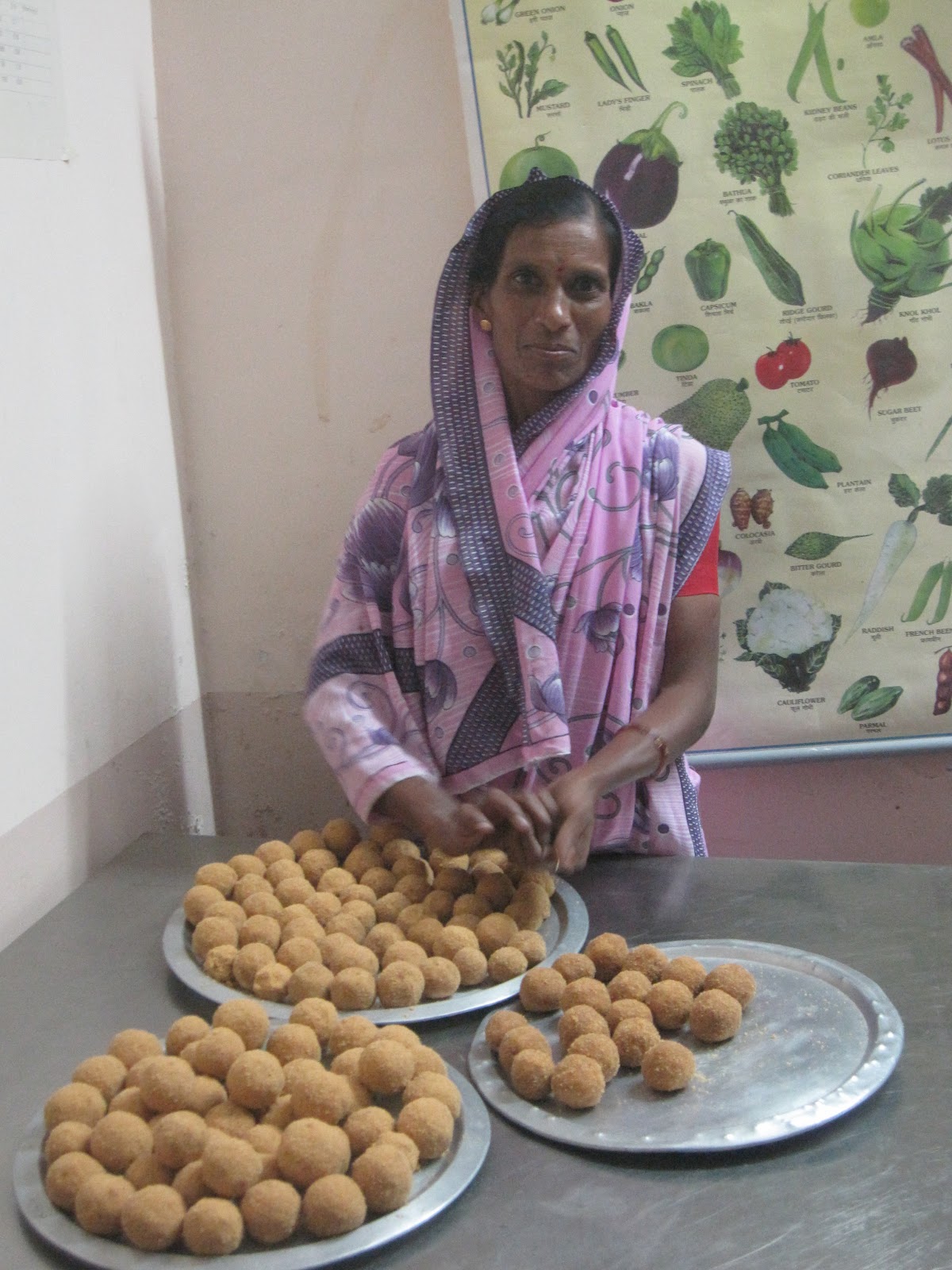
Auntie: the cook in the mess.  Here she is posing in 
front of Ladu (a sweet eaten year-round), which is 
being made specifically for the upcoming Diwali holiday.
Tip 3: Yes…or No.  The Indian Bobble Head           
I fully blame the Barwani family for not educating me around this bit of Indian culture before arriving in India.  For those of you watching “Outsourced”, you may be familiar with this.  For everyone else, I’ll do my best to explain.  The Indian Bobble Head is a facial gesture to any question that requires a yes/no answer (or anything in between).  Now, it looks like a “no” head nod from side-to-side, but in fact requires a soft “figure 8” movement of the chin.  In effect, it makes one look like their head is similar to that of a bobble head doll.  The meaning of such movements:  Well, I had originally learned that it meant a solid “Yes” (which is confusing given the side-to-side motion similar to our “No”).  However, my time here in Anadur has shown me that this simple head gesture is far more complex.  It can be interpreted to mean anything from a simple “Yes” to an “I Understand” or an Indian “Yes” (which means that I might know the answer, just not exactly to the question you’re asking), to a “Maybe”.  I have not yet seen it mean a solid “No”, but I’m not holding that out as an option.  So, in other words, I have to do my best to interpret this head gesture ON TOP of the whole new language thing.  I guess it never ends.

I think that may be enough cultural immersion for now.  But next update, be prepared.  Diwali is coming November 5 (the Indian version of Christmas/Hanukah) and I have a trip to Pune and Mumbai planned!  Definite excursions ahead.

Andrew
And just in case you forgot how your far-away 
friend looked.  Here's me posing in front of the 
Fort in Solapur.